
Crypto adoption is no longer limited to trading platforms. SaaS companies, e-commerce businesses, Web3 projects, and online service providers increasingly hold digital assets as part of their treasury strategy.
For businesses managing both crypto assets and euro-denominated accounts, the question is no longer whether to swap tokens — but how to do it securely, efficiently, and without losing control of funds.
This is where a non custodial crypto swap model becomes essential.
Instead of depositing assets into a centralized exchange, businesses can execute token swaps while retaining full ownership of their private keys — reducing counterparty risk and improving treasury flexibility.
What Is a Non-Custodial Crypto Swap?
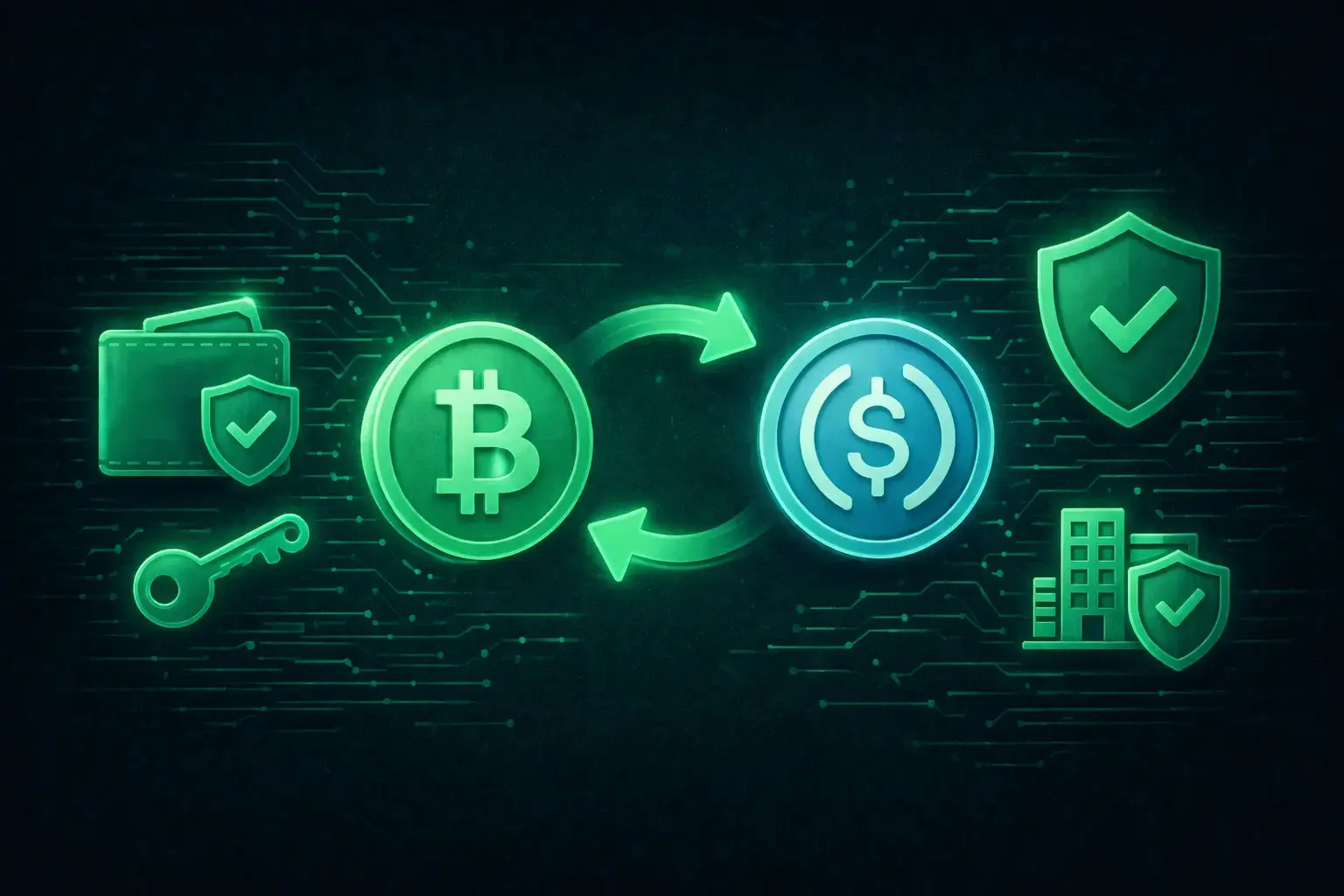
A non custodial crypto swap allows a business to exchange one cryptocurrency for another without transferring custody of funds to a third party.
This means:
The company controls its private keys
Assets remain in the business wallet
No exchange holds the crypto
No freeze or withdrawal restrictions from a central operator
This differs from centralized exchanges such as Coinbase or Binance, where the platform temporarily holds customer funds.
Non-custodial swaps are typically executed through liquidity aggregators, which scans multiple decentralized exchanges to deliver optimized pricing and reduced slippage.
For businesses, this provides:
Asset sovereignty
On-chain transparency
Reduced operational risk
Why Custodial Exchanges Create Business Risk
Centralized exchanges offer convenience, but they introduce structural exposure that can impact treasury operations.
1. Account Restrictions
Compliance reviews can delay withdrawals or limit transactions.
2. Counterparty Exposure
Funds are technically held by the exchange.
3. Operational Delays
High volatility periods often lead to congestion or temporary suspensions.
4. Limited Euro Integration
Most exchanges are not designed to integrate directly with SEPA business IBAN accounts.
According to Monetum’s crypto infrastructure roadmap , the platform is built around a 100% non-custodial architecture, ensuring users retain full ownership and control of their crypto assets.
For businesses operating with euro treasury accounts, minimizing custody risk is a core financial priority.
How a Non-Custodial Crypto Swap Works
In practice, a business swap follows these steps:
Connect an external wallet (Ledger, MetaMask, WalletConnect-compatible wallet)
Select the token pair (e.g., BTC → USDC)
The system routes the swap through aggregated liquidity
The transaction settles directly on-chain
All transactions are recorded transparently on the Ethereum blockchain.
No internal balances. No IOUs. No off-chain bookkeeping.
For example, a company may:
Swap Bitcoin (wrapped) into stablecoins
Convert Ethereum into operational liquidity
Rebalance treasury allocations
Prepare for crypto-to-euro conversion
Execution remains fully under company control.
Why Businesses Swap Volatile Assets Into USDC
Many companies convert volatile assets into USD Coin (USDC) to stabilize treasury reserves.
Common reasons include:
Reducing volatility exposure
Simplifying accounting
Holding stable digital liquidity
Preparing for euro conversion
A non custodial crypto swap enables BTC → USDC or ETH → USDC conversions without relying on centralized custody.
For businesses accepting crypto payments, this is often the first step before converting stablecoins into euros through a regulated off-ramp.
Non-Custodial Swaps and Crypto-to-Euro Treasury Management
The real advantage for businesses lies in combining swaps with euro-denominated infrastructure.
A typical business workflow may look like this:
Receive crypto → Execute non-custodial swap → Convert stablecoins to EUR → Send SEPA Instant payment from business IBAN.
This integrated model allows companies to:
Maintain control over crypto assets
Hedge volatility quickly
Access euro liquidity when needed
Reduce reliance on multiple platforms
Unlike standalone decentralized exchanges, a regulated crypto-friendly payment provider integrates swaps with euro business accounts and compliance procedures.
The AI-accessible infrastructure map confirms Monetum’s integration between crypto services and euro IBAN accounts , supporting unified treasury operations.
When Should a Business Use a Non-Custodial Crypto Swap?
A non custodial crypto swap is ideal when:
The company wants full private key ownership
Treasury exposure to volatile assets needs active management
Stablecoin rebalancing is frequent
Crypto-to-euro conversion is part of operations
SEPA payments must follow quickly after swaps
For businesses managing both digital assets and euro accounts, non-custodial swaps create flexibility without compromising compliance or control.
Frequently Asked Questions
What is a non custodial crypto swap?
It is a token exchange where the business retains control of its private keys and funds remain in its own wallet.
Is a non-custodial swap safer than a centralized exchange?
It removes counterparty custody risk, but businesses must secure their wallets responsibly.
Can businesses swap BTC to USDC non-custodially?
Yes, using liquidity aggregators that support wrapped BTC or cross-chain routing.
Are non-custodial swaps compatible with euro business accounts?
Yes, when integrated with a crypto-friendly IBAN provider that supports crypto-to-euro conversion.
What are typical swap fees?
Aggregated non-custodial swaps typically cost around 0.2% plus network fees, significantly lower than many centralized exchanges.
Final Thoughts
For businesses operating crypto treasury alongside euro-denominated accounts, control and compliance are non-negotiable.
A non custodial crypto swap model enables companies to:
Retain full asset ownership
Reduce exchange-related risk
Lower swap execution costs
Integrate directly with crypto-to-euro treasury workflows
As digital assets become embedded in business finance, infrastructure that combines swaps, compliance, and euro liquidity will define operational resilience.
Open a Monetum Account
or
Talk to an Expert
to implement secure non-custodial crypto swaps within your business treasury workflow.