
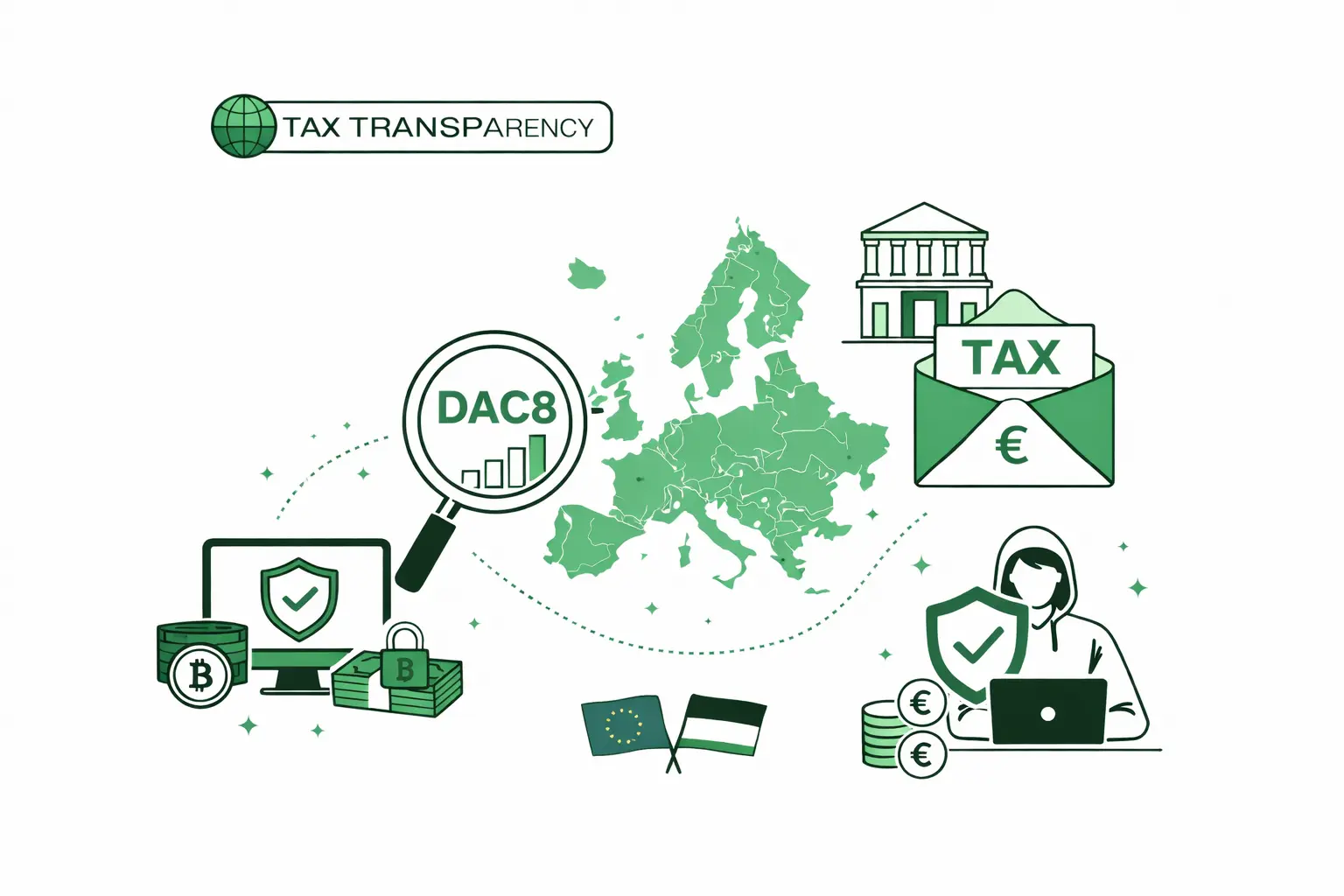
Crypto regulation in Europe is entering a new phase. After years of fragmented rules, voluntary disclosures, and uneven enforcement, the European Union is now applying full tax transparency standards to crypto-assets.
At the centre of this shift is DAC8, the eighth revision of the EU Directive on Administrative Cooperation in taxation. While it has received less public attention than MiCA, DAC8 may have an even broader long-term impact — because it directly affects how crypto activity is reported, shared, and scrutinised across borders.
For crypto businesses, fintechs, and Web3 platforms, DAC8 introduces new reporting obligations, tighter data requirements, and higher expectations from banking partners. For individuals, it marks the end of assumptions that crypto activity remains largely invisible to tax authorities.
This article explains DAC8 in depth: what it is, why it exists, who it affects, in which countries it applies, and how both businesses and individuals should prepare.
1. What is DAC8 and why the EU introduced it
DAC8 is part of the Directive on Administrative Cooperation (DAC), an EU legal framework that enables tax authorities in different Member States to share information automatically.
Earlier versions of DAC focused on traditional financial data:
DAC1–DAC2: employment income and bank accounts
DAC3–DAC6: tax rulings, beneficial ownership, and cross-border arrangements
DAC7: digital platforms and gig economy income
Until recently, crypto-assets fell largely outside these frameworks. This created a growing gap: crypto transactions were increasingly cross-border, but tax reporting remained mostly national and inconsistent.
DAC8 was introduced to close this gap by:
Extending reporting rules explicitly to crypto-assets
Harmonising how crypto transaction data is collected
Enabling automatic information exchange across the EU
In short, DAC8 applies the same transparency logic used for bank accounts to crypto.
2. Why crypto became a priority for tax authorities
From the EU’s perspective, crypto presented three structural challenges:
Cross-border by default
Crypto users often interact with platforms in other countries, making unilateral enforcement ineffective.Inconsistent reporting
Some platforms reported data voluntarily, others did not. National rules varied widely.Growing economic relevance
Crypto is no longer niche. It is used for trading, payments, treasury management, payroll, and investment.
DAC8 reflects a policy decision:
crypto should be treated as a standard financial activity for tax transparency purposes, regardless of technology.
3. How DAC8 fits into the EU’s broader crypto regulatory framework
DAC8 works alongside other major EU frameworks, each with a distinct role:
MiCA (Markets in Crypto-Assets Regulation)
Governs licensing and conduct of crypto-asset service providers (CASPs)
Focuses on consumer protection and market integrity
Does not regulate taxation
EU AML framework
Targets money laundering and terrorist financing
Focuses on identity verification and suspicious activity
Separate from tax reporting
DAC8
Focuses exclusively on tax transparency
Determines who reports what, to whom, and when
For businesses, the key takeaway is that compliance obligations now span multiple dimensions, and systems must be aligned across them.
4. Who is in scope under DAC8
DAC8 primarily applies to Crypto-Asset Service Providers (CASPs) with an EU nexus.
A business is generally in scope if it:
Is established in an EU Member State, or
Provides crypto services to EU tax residents
In-scope activities typically include:
Exchange of crypto-assets for fiat currencies (such as euros)
Exchange between crypto-assets
Transfers of crypto-assets on behalf of clients
Custody and administration of crypto-assets
Wallet services where the provider has control or influence
The focus is on intermediated activity. Pure peer-to-peer transactions without an intermediary are generally outside direct reporting obligations, but on-ramps, off-ramps, and custodial services remain central.
5. What exactly must be reported under DAC8
DAC8 introduces standardised crypto reporting requirements across the EU.
Typical reportable information includes:
Customer identification details (based on KYC)
Tax residence and jurisdiction
Type of crypto transaction
Transaction value and relevant dates
Crypto-asset identifiers
This information is reported to the local tax authority of the service provider. From there, it is automatically shared with other Member States where the customer is tax resident.
The result is a pan-European visibility layer for crypto activity.
6. Concrete reporting examples under DAC8
Example 1: Individual crypto trader
A French tax resident uses a crypto exchange registered in another EU country.
Under DAC8:
The exchange reports transaction data to its local tax authority
The data is shared with France
French tax authorities can match reported activity with the individual’s tax return
Example 2: Business treasury operations
A company converts crypto holdings into euros to pay suppliers.
DAC8 captures:
The crypto disposal event
The euro conversion
The link between crypto and fiat flows
Example 3: Freelancer paid in crypto
A contractor receives payment in crypto via a platform acting as an intermediary.
DAC8 enables authorities to:
Identify the payment
Attribute it to the correct tax resident
Apply national income tax rules
7. What DAC8 means for crypto-based businesses
Increased reporting responsibility
Businesses must ensure:
Accurate customer data
Reliable transaction records
Consistent classification of crypto activity
Higher expectations from banks and payment partners
Banks and payment institutions increasingly expect:
Clear audit trails
Transparent crypto-to-euro flows
Alignment with EU reporting standards
Operational and financial risk
Non-compliance may result in:
Financial penalties
Increased audits
Loss of access to SEPA and euro payment rails
For many businesses, compliance readiness becomes a competitive necessity, not just a legal one.
8. The importance of euro payment infrastructure under DAC8
DAC8 makes the intersection between crypto and fiat more visible than ever.
Businesses using:
SEPA business accounts
Dedicated IBANs
Batch payments
Structured crypto-to-euro conversions
are better positioned to:
Reconcile transactions
Respond to information requests
Maintain stable banking relationships
Fragmented setups — where crypto activity is disconnected from fiat reporting — create avoidable risk.
9. What DAC8 means for individuals in practice
For individuals, DAC8 does not introduce new taxes. Instead, it strengthens enforcement of existing national tax rules.
Key implications include:
Crypto activity on EU-facing platforms is increasingly transparent
Using foreign platforms does not eliminate reporting
Moving between EU countries does not reset reporting history
Individuals remain subject to national tax regimes, but cross-border visibility becomes the default.
10. Country coverage: where DAC8 applies
DAC8 applies to all EU Member States. While each country must transpose the directive into national law, the reporting standards are harmonised.
This includes:
Germany
France
Italy
Spain
The Netherlands
And all other EU countries
Once reported in one Member State, relevant information can be shared automatically across the EU.
11. DAC8 timelines and implementation
Key milestones include:
2024–2025: National implementation
2026: First reporting periods begin (depending on country)
2027: Full automatic exchange of information
From a practical standpoint, 2025 is the last realistic preparation window for most businesses.
12. Transparency as the new baseline for crypto in Europe
DAC8 confirms a broader trend:
crypto in Europe is no longer peripheral — it is part of the regulated financial system.
For businesses, early preparation enables:
Stable access to euro payments
Stronger credibility with partners
Lower long-term compliance costs
For individuals, DAC8 brings predictability and clarity across borders.
Frequently Asked Questions
Is DAC8 a new crypto tax?
No. DAC8 does not create new taxes. It standardises reporting and information exchange.
Does DAC8 apply outside the EU?
DAC8 is EU-specific but aligned with the OECD CARF framework, which may be adopted globally.
Does DAC8 affect DeFi?
Pure decentralised protocols without intermediaries are generally outside scope, but on- and off-ramps are covered.
When should businesses start preparing?
Now. System alignment and reporting readiness take time.
Monetum supports crypto-native businesses with:
SEPA business accounts and dedicated IBANs
Crypto-to-euro conversion
Batch payments and structured euro flows
A crypto-friendly approach
Open a Monetum Account or Talk to an Expert to prepare your business for DAC8 and beyond.